Pumbit Care Table

How do you design care that arrives before a mother has to ask for it?
Where

Stanford d.school

Context

MS Design Thesis

Collaborators

Skills

  • Systems design

  • Product design

  • Needfinding

  • AI-integrated prototyping

Overview

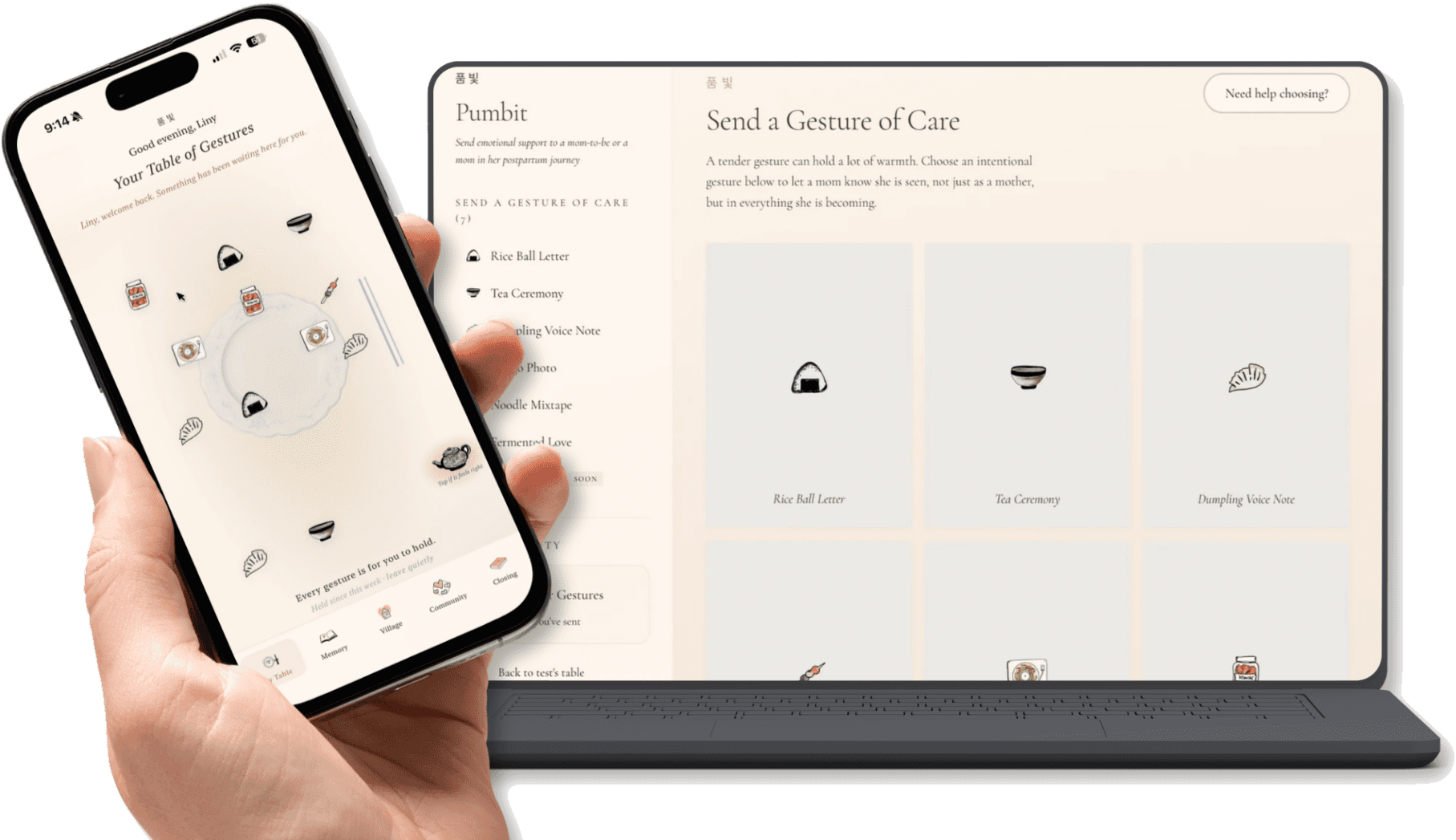
Pumbit Care Table is a relational care platform I designed for my Stanford MS thesis, built for second-generation Asian American mothers in postpartum. It started as a question about maternal mental health and became a question about what care actually means for these mothers. The answer was emotional witnessing: care that arrives before a mother has to ask. Pumbit, which means "held by light" in Korean, was my response.

As Content Lead at Then I Met You, I helped develop a 360 marketing campaign for the launch of the brand’s first acid-forward skincare product, the Rosé Resurfacing Facial Mask. I designed the campaign narrative and assets around a thoughtful story of motherhood and the value of self-care.

The Problem

Postpartum is a threshold of immense physical and mental transformation, and while the physical toll is visible, the mental health piece gets lost. Perinatal mood and anxiety disorders affect roughly 1 in 5 new mothers, yet only half receive any care at all. For second-generation Asian American mothers, another layer compounds it: inherited traditions arrive as fragments stripped of context, and the relational village that once held new mothers has eroded. The result is a double abandonment, by the medical system and by the village.

The biggest challenge was building a narrative that honored the brand’s belief in deeper human connection (jeong) and self-care while still educating customers on the product itself. Working with the product development team, I helped develop the mask’s value proposition for the marketing campaign, defining its key benefits, ingredients, keywords, and tone.

Design research

I grew up in Korea, where over 80% of mothers stay at a postpartum care center after birth, places that hold a mother emotionally, where care is structured to arrive on its own. The contrast with the US was stark: mothers here were scrambling to build a village that barely existed, carrying the emotional weight alone.


Through needfinding interviews with mothers, doulas, and village members, one key insight was that mothers were asking to be seen. I also found a clear pattern I came to call the postpartum cliff, where a small village shows up in month one, then support drops sharply by month two, leaving many mothers in survival rather than recovery.


So the gap I designed for was the absence of connection and emotional witnessing. Everything in Pumbit is drawn from the values I saw in those Korean care centers, translated from a physical institution into a relational, digital one, guided by one principle: care that is anticipatory, attuned to a mother's latent needs, and never a burden to receive.

Field notes and photos from postpartum care centers in Korea (Winter 2025)

Designing Pumbit Care Table

Pumbit Care Table puts the mother at the center of an outward-reaching platform with a human village layer, giving her friends and family a language and a tool to send tender, culturally resonant gestures throughout postpartum, without placing the coordination or emotional labor on her. The core design bet: by routing anticipatory gestures through her village, postpartum care shifts from a system that manages her recovery into one that witnesses her emergence.

I built Pumbit across three phases, from hand-drawn warmth to a working, tested prototype:

Some of my doodles and sketches using Papersketch

Careling, the AI layer

Developed with my thesis partner Shawn Smith, Careling is the AI- attunement layer within Pumbit that holds the thread for the months after the village falls away but the mother is still mid-passage. Its entity isn't a therapist or a friend but a translator: a consistent, attuned presence that scaffolds continuity and gives the village language for how to show up for the mother emotionally in a thoughtful, genuine way.

Developed with my thesis partner Shawn Smith, Careling is the AI- attunement layer within Pumbit that holds the thread for the months after the village falls away but the mother is still mid-passage. Its entity isn't a therapist or a friend but a translator: a consistent, attuned presence that scaffolds continuity and gives the village language for how to show up for the mother emotionally in a thoughtful, genuine way.

Where Pumbit Stands

We are actively testing and iterating on Pumbit with mothers and their village members, and the early responses have been the most affirming part of the work. Mothers have described feeling supported without pressure, and what moved me most was that they felt held not just by the platform, but by the people it reconnected them with.


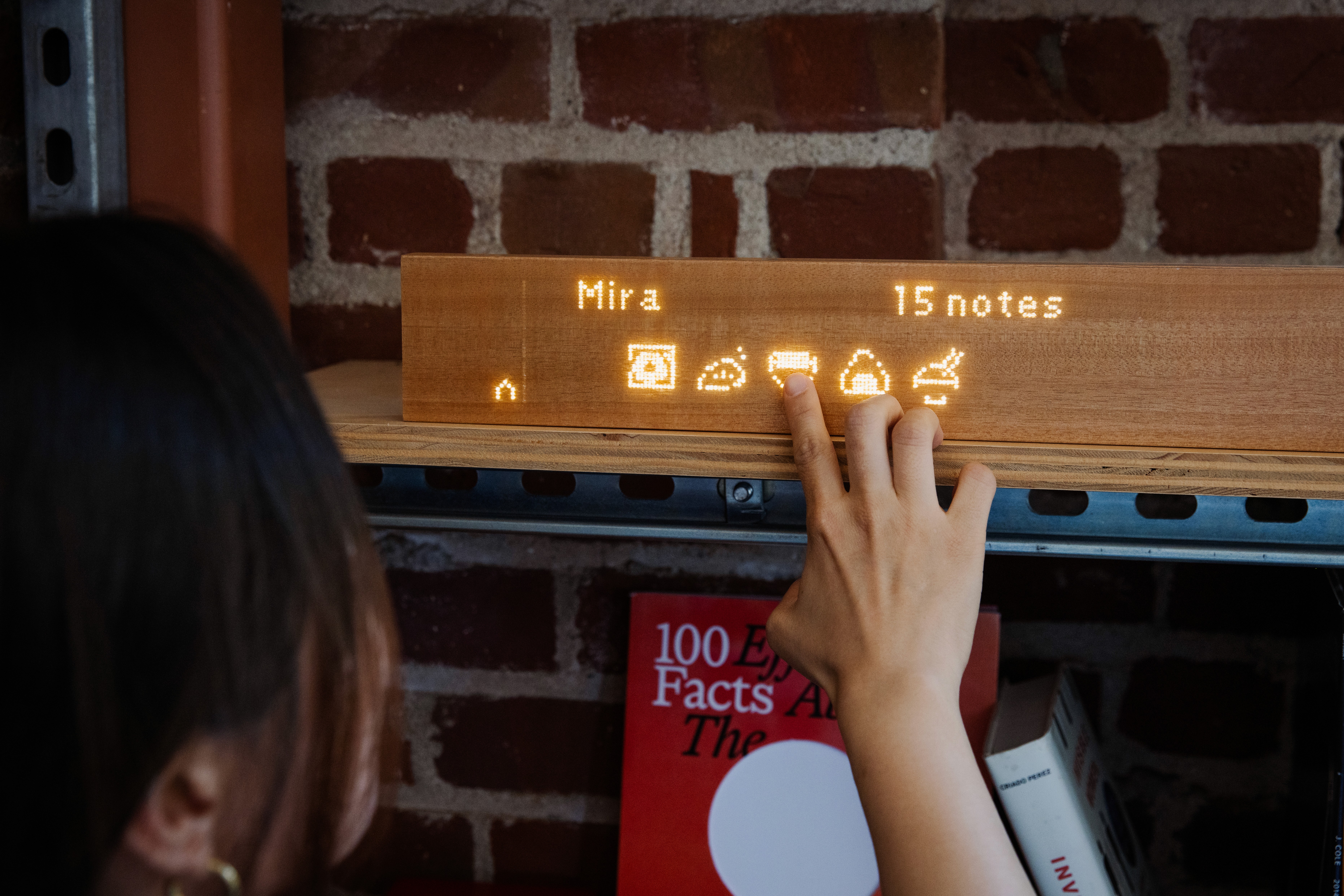
We are also exploring how to bring Pumbit into physical form, experimenting with calmtech interfaces so a gesture from the village can arrive in the home as warmth and presence, rather than on a screen.
The launch was a success, surpassing both our sales and engagement goals. Within three months, the Rosé Resurfacing Facial Mask became the brand’s second-highest-performing product. The campaign’s messaging and its emotionally resonant videos earned recognition from our community and from respected beauty publications, and the mask went on to win an Editor’s Choice Award.

Learnings

  • considerate design goes further than empathetic design

  • needfinding is how you navigate ambiguity

  • collaboration mid-project takes real work, but it's worth it

  • considerate design goes further than empathetic design

  • needfinding is how you navigate ambiguity

  • collaboration mid-project takes real work, but it's worth it

LIVE SITE

Check out our current prototype.

Check out our current prototype.

Visit site ↗

Copyright ©Diane Rhim, All right reserved

Copyright ©Diane Rhim, All right reserved

Copyright ©James Parker,

All right reserved